What lives in your gut shapes what happens there.
Your digestive tract is home to a vast community of microorganisms — collectively called the gut microbiota / microbiome. They don’t simply “live” in your gut; they interact with one another and with your intestinal cells, producing metabolites that can influence digestion, immune activity, metabolism, and the gut environment.
And this is where things get interesting: different microbes can perform very different jobs.
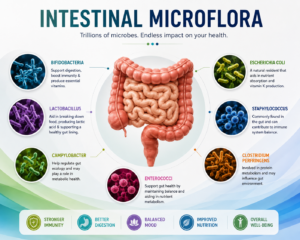
◈ Bifidobacteria can ferment dietary carbohydrates and contribute to the production of metabolites such as acetate and other short-chain fatty acids (SCFAs).
◈ Lactobacilli can metabolize carbohydrates and produce lactic acid and other metabolites. Their effects depend on the particular species and strain, so it’s an oversimplification to assume that every Lactobacillus behaves identically.
◈ Enterococci can be normal members of the gastrointestinal community. However, some strains can act as opportunistic pathogens, particularly when the normal microbial ecosystem or immune defences are disrupted.
◈ E. coli is another great example of why the microbiome can’t simply be divided into “good” and “bad” bacteria. Many strains live harmlessly in the intestine, while other strains can cause disease.
◈ Clostridium species are also part of the intestinal microbial community. Some are harmless or potentially beneficial, while particular species and strains can produce toxins and contribute to illness.
◈ Campylobacter is different again. It is primarily recognized as a gastrointestinal pathogen rather than a beneficial member of the normal gut microbiota.
It’s the ecosystem that matters
A healthy microbiome isn’t necessarily about having the highest possible amount of one particular “good” bacterium.
Researchers increasingly view the gut as a complex ecosystem, where microbial diversity, location, interactions between species, available nutrients, and the intestinal environment all influence how the community functions.
One of the most fascinating examples is short-chain fatty acids.
When certain gut microbes ferment dietary fibre, they produce compounds such as acetate, propionate, and butyrate. These aren’t simply waste products. They can act as signalling molecules and influence the intestinal barrier, immune responses, and metabolism.
And diet is one of the major factors shaping this process. The types and amounts of carbohydrates and fibre reaching the colon influence which microbes can thrive and which metabolites they produce.
Your microbes respond to what you feed them
This is one reason dietary diversity matters.
Rather than focusing exclusively on adding a particular probiotic strain, a broader approach can include a variety of fibre-rich plant foods that provide different substrates for microbial fermentation.
Beans and lentils, vegetables, fruits, whole grains, nuts, seeds, and other minimally processed plant foods can all contribute different types of fermentable carbohydrates.
The goal isn’t to create a “perfect” microbiome. There isn’t one universal microbiome that looks identical in every healthy person.
Instead, the goal is to support a resilient microbial ecosystem that can interact effectively with its host.
The bottom line
Your gut microbiome is far more complicated than a list of “good” and “bad” bacteria.
It’s a dynamic ecosystem — and what microbes are present, what they’re doing, where they’re located, and what they’re being fed can all matter.
Understanding that complexity is changing how researchers think about digestive health, nutrition, metabolism, and the gut–immune connection.
References
- Mukhopadhya I, Louis P. Gut microbiota-derived short-chain fatty acids and their role in human health and disease. Nature Reviews Microbiology, 2025.
- Dagbasi A, et al. Short-chain fatty acids. Nature Metabolism, 2026.
- McCallum G, Tropini C. The gut microbiota and its biogeography. Nature Reviews Microbiology, 2024.
- Mann ER, Lam KY, Uhlig HH. Short-chain fatty acids: linking diet, the microbiome and immunity. Nature Reviews Immunology, 2024.
- Fusco W, et al. Short-Chain Fatty-Acid-Producing Bacteria: Key Components of the Human Gut Microbiota. Nutrients, 2023.

Written By:
Michael Reid
More By This Author