For years, longevity was mostly about one question: How can we live longer?
Today, the conversation is shifting toward something more meaningful: How can we stay healthy, active, independent, and energetic as we age?
That’s the idea behind health span; not simply adding years to life, but supporting the quality of those years.
While longevity headlines often focus on expensive treatments, biohacking, and the latest supplement, many of the strategies with the greatest long-term impact are much simpler.
Here are five habits worth prioritizing.
1. Build and Maintain Muscle
If there’s one area of longevity that deserves more attention, it’s muscle strength.
Muscle naturally declines with age, which can affect mobility, metabolism, balance, recovery, and independence.
Regular strength training can help support:
- Muscle mass and strength
- Bone health
- Blood sugar regulation
- Balance and coordination
- Metabolic health
- Physical resilience
You don’t need to train like an athlete. Consistent resistance training a few times per week can be a powerful investment in your future health.
Think of strength as an asset you want to carry with you into older age.
2. Get Enough Protein
Protein provides the building blocks your body needs to maintain muscle, repair tissue, and support healthy aging.
As we get older, our bodies can become less responsive to dietary protein, making adequate intake increasingly important.
Instead of eating most of your protein at dinner, consider spreading protein throughout the day with:
- A protein-rich breakfast
- A balanced lunch
- Protein-containing snacks when appropriate
- Adequate protein at dinner
The goal isn’t an extreme high-protein diet. It’s making sure your body consistently has the raw materials it needs to maintain strength and function.
3. Pay Attention to Your Metabolic Health
Blood sugar regulation is an important part of healthy aging.
When glucose regulation becomes less efficient, you may notice things like energy crashes, cravings, brain fog, or difficulty concentrating. Over time, insulin resistance can contribute to broader metabolic problems.
The good news? Metabolic health is highly responsive to everyday habits.
Focus on the fundamentals:
- Eat meals built around protein and fibre
- Choose whole foods more often
- Build muscle through resistance training
- Move regularly throughout the day
- Prioritize quality sleep
- Find effective ways to manage chronic stress
These habits work together rather than in isolation.
4. Make Sleep a Priority
Sleep is often treated as something we can sacrifice when life gets busy.
But your body does some of its most important recovery work while you sleep.
Adequate sleep supports:
- Cellular repair
- Hormonal regulation
- Memory and cognitive function
- Immune health
- Metabolic health
- Physical recovery
And sleep can amplify the benefits of everything else you’re doing.
A few simple strategies can help:
- Keep a consistent sleep schedule
- Create a cool, dark bedroom
- Reduce bright light before bed
- Develop a relaxing evening routine
- Address ongoing stress
- Limit habits that interfere with sleep
Longevity isn’t just about what you do during the day. It’s also about how well your body recovers at night.
5. Use Personalized Health Information
Another important shift in longevity is moving away from a one-size-fits-all approach.
Two people can have the same symptom but completely different underlying factors.
Depending on your health history and goals, appropriate testing may provide information about areas such as:
- Blood sugar regulation
- Nutrient status
- Inflammation
- Cardiovascular risk
- Hormonal health
- Metabolic health
- Digestive function
The goal isn’t to order every test available. It’s to use appropriate information to better understand your individual health picture and make more targeted decisions.
Longevity Is About Resilience
Healthy aging isn’t about finding one miracle supplement, treatment, or wellness trend.
It’s about building a body that is strong, metabolically healthy, well-rested, and resilient.
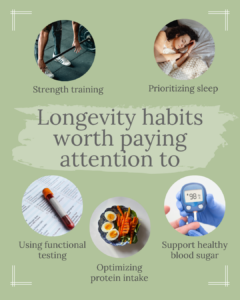
Strength training. Adequate protein. Stable blood sugar. Quality sleep. Personalized care.
These fundamentals may not be as flashy as the latest longevity trend, but they’re among the most practical places to start.
The goal isn’t simply to live longer. It’s to stay strong, capable, and independent for as many of those years as possible.
Ready to take a more personalized approach to healthy aging?
A consultation can help you look at the bigger picture and identify practical strategies based on your individual health goals.
References
- Cribb, V. L., & Hayes, A. (2024). Resistance training and healthy aging: Effects on muscle mass, strength, and functional capacity. Sports Medicine, 54(2), 233-248.
- Devries, M. C., & Phillips, S. M. (2023). Supplemental protein in support of muscle mass and health: Advantage whey. Journal of Food Science, 88(3), 1154-1164.
- Ferrucci, L., Gonzalez-Freire, M., Fabbri, E., Simonsick, E., Tanaka, T., Moore, Z., & Salimi, S. (2024). Measuring biological aging in humans: Current approaches and future directions. Nature Aging, 4(1), 24-38.
- Liu, Y., Ozodiegwu, I. D., Hess, R., & Biehl, M. (2023). The relationship between sleep duration and chronic disease risk. Sleep Health, 9(4), 567-575.
- McGlory, C., Beals, J. W., & Phillips, S. M. (2022). Exercise and the regulation of skeletal muscle hypertrophy. Progress in Molecular Biology and Translational Science, 188, 51-76.
- Miller, V., Webb, P., & Thompson, J. (2024). Personalized medicine and functional health assessment in preventative healthcare. Frontiers in Medicine, 11, 1347285.
- Petersen, M. C., & Shulman, G. I. (2018). Mechanisms of insulin action and insulin resistance. Physiological Reviews, 98(4), 2133-2223.
- Watson, N. F., Badr, M. S., Belenky, G., Bliwise, D. L., Buxton, O. M., & Tasali, E. (2021). Recommended amount of sleep for a healthy adult: A joint consensus statement. Journal of Clinical Sleep Medicine, 17(10), 2115-2116.

Written By:
Michael Reid
More By This Author